Insights on Partnership & Relational Processes
The start of any creative group process begins with relationship building. Our work finds its roots in generative cycles of fellowship.
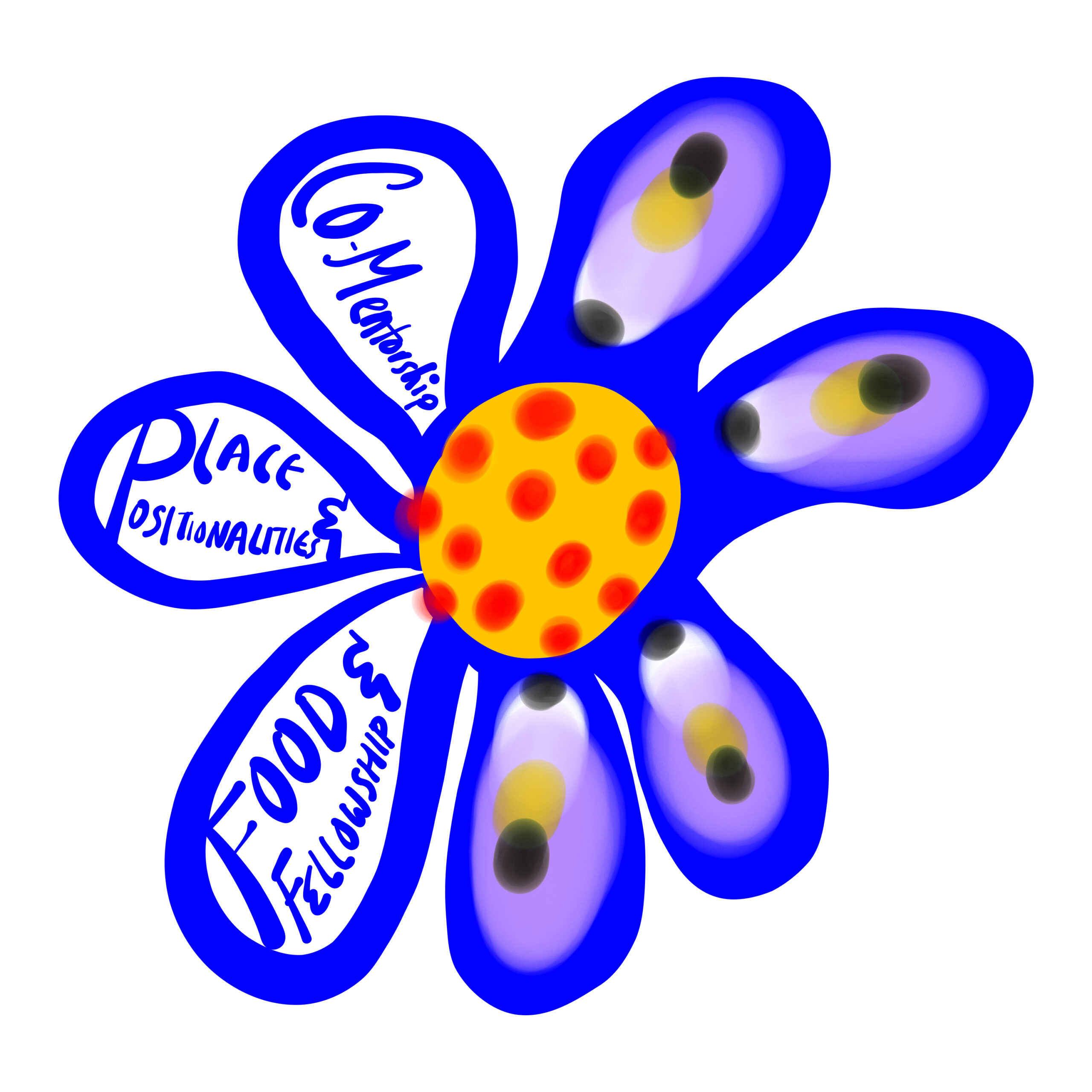
Food & Fellowship
A core organizing team representing three community organizations and one university came together to access funding through the Social Sciences and Humanities Research Council’s Race, Gender and Diversity Initiative.
Through our collective networks, we put out a call for emerging QT/BIPOC artists interested in “gathering to make and share a meal, and dialogue about art activism that moves change”.

Across butcher block tables of a large industrial kitchen, we chopped vegetables and shared our own framings, ideas, and perspectives of arts for social change. From this first meeting we sought an activated and communal aesthetic. We made a meal based on the Pinoy cuisine and heritage of a lead team member.
We discussed addressing coloniality through food relations.
21 artists responded to this open invite. We purposely did not pre-define specific research questions or research creation directions. This led to some confusion and ambiguity of purpose. The artists asked what the project was and what was expected of them. We did not have clear or specific answers. We explored the beginnings of what finding a shared purpose might entail. Participants expressed some confusion, while also feeling enticed and intrigued.
Place and Positionalities
Over subsequent sessions we solidified a core team of 19 emerging artists and 5 facilitators, with broader advisory group support from additional community partner collaborators.
We began with curiosity, respect and honouring of each artist's individual practice.
As opposed to driving too quickly towards determining shared research questions or research creation mediums, we sought instead to live in the rich diversity of practices and perspectives represented by the group. And to first listen to and learn from this collective.
Within these intentions, and our goals of disrupting racist and colonial practices for change, were necessary attentions to personal locations and positionalities .
Notably, this included critical questions about the nature of our mixed facilitator team of racialized and white folks. And connections to broader social and institutional processes of whiteness, privilege and exclusion.
We reframed our first collective session to take these issues up directly in dialogue, with a focus on personal storytelling for reflexively locating ourselves and our histories.

These early sessions called in continual and purposeful attention to how team members of different identities hold role and space. In particular, the need for naming and addressing tensions around how white people partner with racialized people and communities. As a team we refocused to centre lead facilitation by racialized team members. And to deepen dialogue about how to be in collaboration across differences, that recognizes the inherent challenges to engagement for racialized folks in spaces of historical white dominance.
We sought to hold space for response, rather than being unduly focused on session goals or deliverables.
A result of these processes was renewed imperative to adapt and shift in response to the artists, prioritizing self-determination, accessibility and accommodations. This included adapting artist stipends to include specific portions for addressing needs/accommodations, to be used by each artist at their discretion based on their personal circumstances.
Co-Mentorship
The final sessions in this phase centered on artistic co-mentorship.
We invited established socially-engaged artists to dialogue and jam with the emerging artists, sharing their arts advocacy experiences, and inquiring with and from the emerging artists perspectives.

The group received a powerful teaching inviting us to think of ourselves as future ancestors.
This emotional and relational moment seemed to open an almost fulcrum shift in the emerging artists’ sense of ownership/voice within the project. With this concept directly influencing their research creation questions, foci and directions.
The co-mentorship approach was characterized by an ebb and flow between large group work, and smaller more intimate collabs. In group sessions we moved between small group work for intensive ideation, and larger group processes for sharing and feedback.
Smaller spaces also included care pod check-ins structured to function as peripheral support and design mechanisms, between large group in person sessions. The emerging artists were able to select amongst identified project mentors and meet with them and a smaller group of their peers. Care pods were held in two cycles, in between two large team meetings.